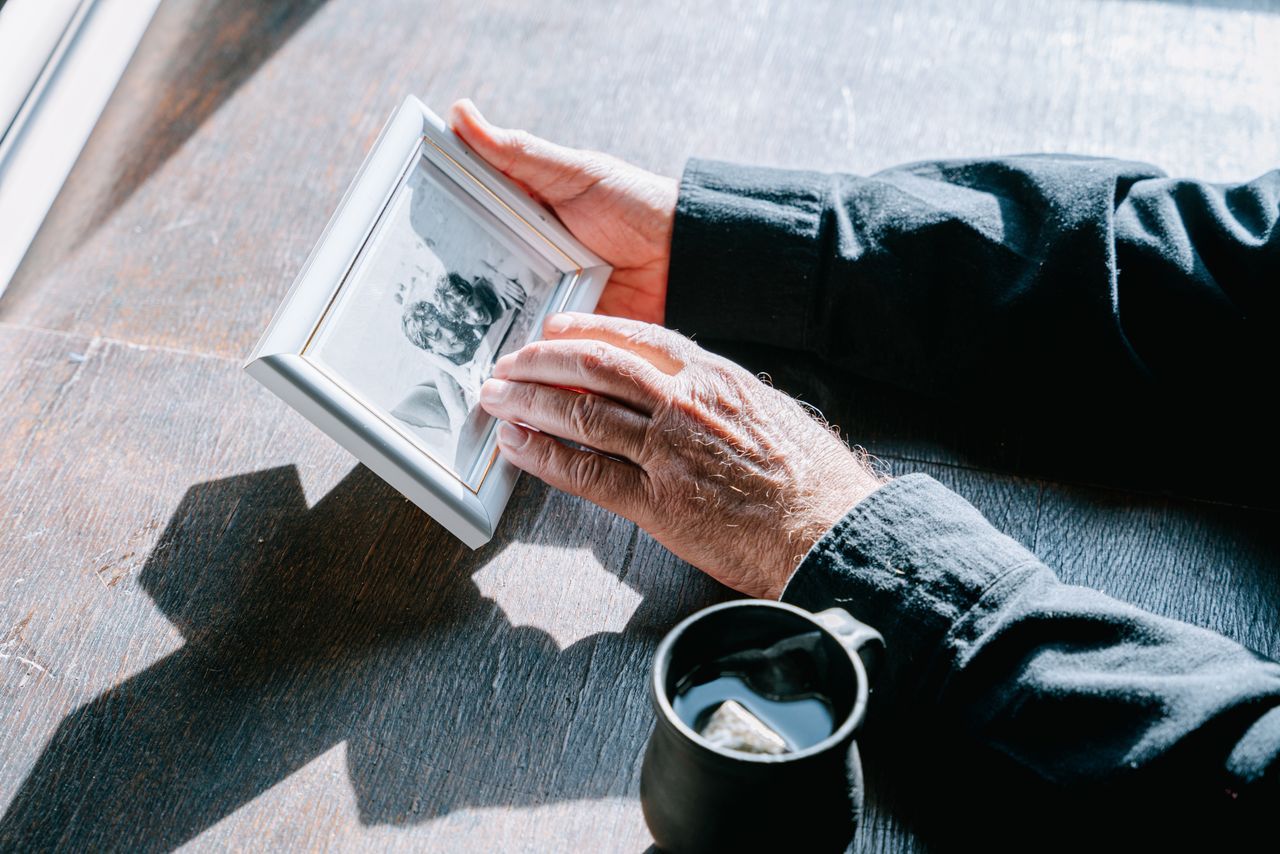
If you've spent any time researching dementia care, you've probably come across the term "reminiscence therapy." It gets mentioned a lot, in care home brochures, in blog posts like this one, in advice from occupational therapists. But what actually is it, and is it just a nice idea, or does it genuinely help?
Here's a straightforward answer to both questions.
What reminiscence therapy actually is
Reminiscence therapy is the practice of using memories, usually prompted by photographs, music, objects, or familiar smells, as a structured way to help someone connect with their past and with the people around them. It can be done one-on-one or in a group, led by a therapist or by a family member with no training at all. There's no single fixed method. What matters is the aim: using something tangible from someone's past to spark recognition, conversation, or simply a feeling of familiarity.
It was first proposed in the 1960s by Dr Robert Butler, a psychiatrist working in geriatric medicine, who introduced the idea of "life review", the notion that looking back on one's life in later years is a healthy, natural process rather than something to be discouraged. At the time, this was a fairly radical idea. Talking about the past was often seen as "living in the past" and a sign someone wasn't coping with the present. Butler argued the opposite, and life review has since become one of the foundations of person-centred dementia care.
Why it works differently for people with dementia
For most of us, memory works roughly chronologically: yesterday is clearer than a decade ago. Dementia often flips that. Short-term memory, what was said five minutes ago, what was eaten for lunch, tends to fade first. Long-term memories, especially ones tied to identity, emotion, and repetition (a wedding day, raising children, a childhood home), are frequently preserved far longer.
This is the mechanism reminiscence therapy leans on. It doesn't try to strengthen short-term recall, which is often not realistic. Instead, it works with whatever memory is still intact and accessible, using it as a bridge to connection in the present moment. That's an important distinction: the goal isn't to test what someone remembers, it's to give them an opening to communicate on their own terms.
What the research actually says
Reminiscence therapy, using memories, photos, and familiar objects as a structured way to connect, has a decent body of evidence behind it. A 2021 systematic review and meta-analysis of five randomised controlled trials found that reminiscence therapy led to a significant improvement in quality of life among people with mild to moderate dementia in long-term care, alongside some benefit for autobiographical memory, even though effects on depression and cognition were less consistent across studies (Thomas & Sezgin, 2021, Geriatric Nursing). A separate pre-post study of group reminiscence therapy in people with moderate to severe dementia found significant improvements in wellbeing and a reduction in behavioural and psychological symptoms after just eight sessions over four weeks.
None of this means reminiscence work is a cure or a guarantee. But it does mean that the instinct so many families have, to reach for old photos and old songs, isn't just sentimental. It's supported by real evidence that these activities can genuinely improve day-to-day wellbeing.
Where the evidence is less clear
It's worth being honest about the limits, too. Across the wider body of research, results are mixed. Some studies find real improvements in mood, socialisation, and quality of life. Others find little measurable change, particularly for cognition and depression specifically. Part of the difficulty is that reminiscence therapy isn't standardised, one study's version might be eight structured group sessions with a trained facilitator, while another is a single family member showing photos at the kitchen table. That variation makes it hard to draw one clean conclusion.
What the evidence does support fairly consistently is quality of life and wellbeing in the moment: people seem calmer, more engaged, and more able to connect during and shortly after reminiscence activities, even when longer-term cognitive gains aren't detectable. For most families, that in-the-moment connection is the actual goal anyway.
What this means for you, practically
You don't need a therapist, a training course, or a formal programme to use reminiscence therapy with your own parent. The research suggests the core ingredients are simple:
- A tangible prompt: a photo, an object, a piece of music
- Something drawn from an earlier, well-established period of their life
- Low pressure, this is an invitation to respond, not a test
- Repetition over time, rather than a single attempt
Consistency seems to matter more than any particular format. A few minutes with an old photo, done regularly, is likely to do more than one long, ambitious session that never happens again.
A gentle place to start
If you like the idea of reminiscence therapy but don't know where to begin, that's exactly the gap ReelLife Conversations was built for. It turns your own family photos into guided conversation prompts, so you're not starting from a blank page every time you sit down together.
Reminiscence therapy isn't a fix for dementia, and no research claims it is. But the evidence, and the experience of countless families, points to something real: a photo, a song, a shared memory can still open a door, even on the hardest days.